
404
Sorry you've reached this page by mistake
ADHD Learning Pathways Blogs
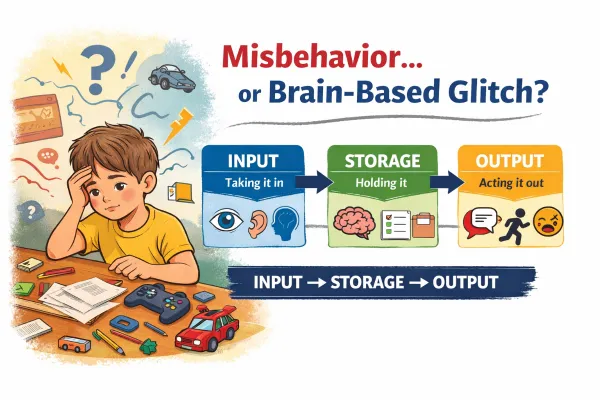
Is It Misbehavior or ADHD? A Brain-Based Look at Chaos
What if your child’s chaos isn’t misbehavior… but a brain-based glitch?
If you’re living in the land of lost shoes, half-finished homework, emotional whiplash, and “I SWEAR I told you three times”… you’re not alone.
And here’s the plot twist most good parents never get told:
Your child may not be choosing chaos.
They may be experiencing a brain-based processing glitch.
That doesn’t mean “broken.” It means wired differently—and when the wiring is different, the behavior looks different.
So instead of asking, “Why won’t you listen?”
A better question becomes:
“What’s happening in the processing pipeline?”
Because ADHD is often less about “bad behavior”… and more about how information gets in, where it gets stored, and how it comes out.
ADHD isn’t defiance. It’s often a processing mismatch.
Most parents try to fix ADHD behaviors at the behavior level:
“Try harder.”
“Pay attention.”
“Stop interrupting.”
“Think before you act.”
Which sounds logical… until you realize you’re asking a child to use a skill their brain isn’t reliably accessing in that moment.
ADHD commonly shows up as:
Inattentiveness (missed instructions, drifting off, “what?”)
Impulsivity (blurting, grabbing, reacting fast)
Inconsistent follow-through (great intentions… incomplete output)
Not because they don’t care.
Because the brain’s processing system is lagging—like a browser with 42 tabs open.
Here’s the simple model we teach and train:
✅ Input → Storage → Output
When those three stages get stronger, the child doesn’t just behave better—
They feel more capable, calmer, and more confident.
Stage 1: INPUT
“Getting it in clearly… the first time.”
Input is what happens when your child takes in information through:
hearing
vision
body awareness (movement, balance, coordination)
attention control
When Input is glitchy, life looks like:
“I didn’t hear you.” (even when you were 3 feet away)
staring at directions but not absorbing them
missing key details
needing repetition… and more repetition… and then a meltdown
The goal isn’t yelling louder.
It’s helping their brain receive information more cleanly.
Bright graphic (Input):
🟦 INPUT
⬇️ Information comes in
👀 Seeing • 👂 Hearing • 🧠 Attention • 🧍 Body awareness
Stage 2: STORAGE
“Holding onto it long enough to use it.”
Storage is where the brain organizes and retains information long enough to:
remember instructions
stay on task
recall what they just read
keep track of the steps in order
When Storage is glitchy, it looks like:
forgetting what they were doing mid-task
losing their place constantly
“I know it… I just can’t remember it right now.”
starting strong… finishing nowhere
And here’s the part parents feel in their bones:
It’s exhausting watching your child want to do well…
and still get derailed by invisible brain friction.
Storage can be trained—especially when you train the underlying neurological processes, not just “study skills.”
Bright graphic (Storage):
🟩 STORAGE
⬇️ Information gets organized + held
🧠 Working memory • 🧩 Sequencing • 🧭 Direction • 🗂️ Recall
Stage 3: OUTPUT
“What comes out… as actions, words, work, and behavior.”
Output is what your child produces:
speech
writing
emotional responses
physical actions
decision-making
This is where impulsivity often shows up.
When the output is glitchy, it looks like:
blurting or interrupting
acting before thinking
explosive emotions that feel “too big.”
rushing through work and making careless mistakes
shutting down when overwhelmed
A lot of parents interpret Output problems as:
“He’s being disrespectful.”
“She’s being dramatic.”
“They’re doing it on purpose.”
But very often it’s this:
Their brain is producing a response before it has fully processed the moment.
When Output becomes more regulated, the child experiences something powerful:
pause → choice → control
That’s not just better behavior. That’s a better life.
Bright graphic (Output):
🟨 OUTPUT
⬇️ The brain responds + produces
🗣️ Words • ✍️ Work • 🧍 Actions • ❤️ Emotions • ⏸️ Self-control
So… what does your program actually train?
Our approach doesn’t rely on “motivation” or “willpower” (which is wildly unreliable with ADHD brains—especially when stressed).
We train the brain’s processing system:
Strengthen the input so information lands cleanly
Improve Storage so it sticks and can be used
Regulate Output so responses become more intentional
We do this through structured brain-based activities (not just worksheets), designed to build the underlying neurological processes that support learning, behavior, and confidence.
Your loved one isn’t “too much.” Their brain is just asking for a better system.
If ADHD has turned your home into constant reminders, arguments, and exhaustion… you’re not failing. You’re just missing a brain-based framework.
A lot of what looks like “not listening” or “not trying” is often a skills gap under stress—how the brain handles Input → Storage → Output. When that processing pipeline gets stronger, daily life gets calmer and more consistent: better focus, better follow-through, and fewer blow-ups.
At ADHD Learning Pathways, we help parents and partners learn how to support their loved one with practical, brain-based training—so you can stop guessing and start moving from confused → clear → confident, together.
👉 Learn more about how you can help your child or partner with ADHD at ADHD Learning Pathways