Stop managing the struggle. Start building the skills underneath it.
A parent-led executive function skills program you do at home, for bright kids and teens who are trying hard and still struggling with focus, reading, homework and big emotions.
Enroll in the Youth ProgramSee what's included →
You can see how smart they are. So why is it this hard?
The daily reality
- Homework is a nightly battle: tears, stalling, "I can't."
- Reads a page and can't tell you what it said.
- Spelling words are gone by Friday.
- Starts strong, never finishes, loses everything.
- Meltdowns over small things, then shame afterward.
- Acting up at school, or pulling back and not wanting to go.
And maybe you've already tried
- Tutoring that added more of the same work.
- Behavior charts, rewards and consequences.
- Apps, planners and "just try harder."
- A diagnosis that explained it, but didn't change it.
- Support that helped some, but didn't build the skills.
If you've been burned before, we understand. You've watched strategies work for everyone else's child. This works on what's underneath.

Your child doesn't need another label. They need a plan.
Your child isn't broken, lazy or a troublemaker. Some of the skills underneath learning haven't been built yet, and skills can be trained.
Many of these kids are hands-on, 3D learners. They shine at the kitchen table and on the ball field. Then school hands them a 2D world of pages, screens and tests.
You need a structured, practical approach you can use at home, with confidence.
Behavior is often a learning struggle in disguise
Charts and consequences work on what shows. They often feel like band-aids, because the missing piece is underneath.
Kids can't opt out of school. When it's hard every day, the stress comes out as acting up, melting down, shutting down or refusing to go.
Often it's energy with nowhere to go. As the skills build, that energy has somewhere to work.
1. Input
Taking it in.
"Were you even listening?"
2. Storage
Holding and processing it.
"We just went over this."
3. Output
Acting on it.
"You know it. Why didn't you do it?"
A gym for the brain
We don't treat a label. We train capability. Ten instruments sit behind school, sports and life, and each one can be trained.


Schools say, "Stop moving so you can learn."
We say, "You may need to move to learn."
Does one of these look like your child?
The AnchorFocus
What you see: Drifts during class and homework. Can't finish the last 10%.
What we train: Holding attention long enough to get the job done.
Train TracksTracking
What you see: Skips lines, loses their place, reads the same sentence twice.
What we train: Moving smoothly across a page and copying from the board.
The HighlighterFigure-ground
What you see: Overwhelmed in a noisy classroom. Misses the instruction.
What we train: Filtering out noise to lock onto what matters.
The ScreenshotVisual memory
What you see: Studies spelling all week and forgets it by the test.
What we train: Taking a mental picture of words and facts, and keeping it.
Internal CompassDirection
What you see: Reverses b and d. Mixes up left and right.
What we train: Knowing direction automatically, on paper and on the field.
Internal RulerSize
What you see: Everything is an emergency. No sense of how long homework takes.
What we train: Sizing up the moment and the task.
The assessment shows which of the ten are strong and which need training.
Foundation first, then schoolwork, then reading
Each step builds on the one before it.
Build the foundation
- Telling sounds apart
- Visual processing and memory
- Fine and large motor coordination
- Attention, focus and working memory
- Handling sensory input
Apply it to schoolwork
- Writing and handwriting
- Spelling patterns and rules
- Processing speed
- Basic math concepts
Advance the reading
- Reading fluency
- Comprehension and recall
- Thinking critically about what they read
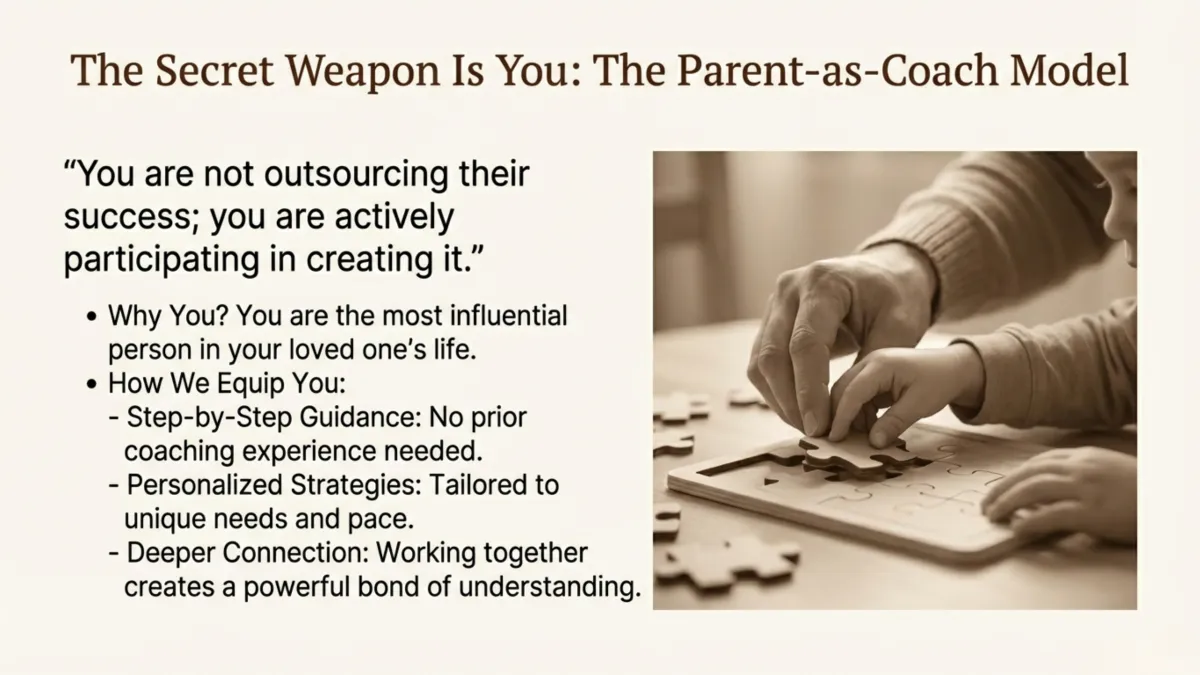
The secret weapon is you
You are not handing off their success. You are helping create it.
No one knows your child better than you do. You don't need to be an expert. Each exercise comes with a how-to video and written instructions.
Your job is not to lecture. Ask, "Did you notice something?" Don't hand them the answer. Help them see it.
With teens especially, steady and positive support matters.
Four steps, at home
Take the assessment
It's included. See your child's strengths and gaps.
Your equipment arrives
The training tools ship to your door, and you get online access.
A module opens each week
Watch the how-to video or read the written instructions, then do the exercises together. Each can be made easier or harder.
Practice and build
About an hour a day, five days a week, for about six months. Go at your child's pace.
From daily struggle toward independence
These are the goals of the training. Every child is different.
Everything you need to train at home
Success Navigator Assessment
Where your child is strong and where the gaps are.
26 training modules
About 8 to 10 physical and mental exercises each. Not screen games.
How-to videos and written instructions
For every exercise, with simpler versions to start with.
All program equipment
Free shipping in the lower 48 states.
Printable PDF worksheets
View them online or print them.
Help by email
Stuck on an exercise? Send us your question.
Success Navigator Youth Program
- Assessment included
- 26 modules
- How-to videos and written instructions
- All equipment shipped
- Email support
What families have seen
Individual experiences. Results vary with the child and the work put in.
Be honest with yourself first
This fits if
- Your child is 7 to 18 and bright but struggling.
- You can lead the training at home.
- You can set aside about an hour a day, five days a week.
- You're ready for steady progress over months.
This is not for you if
- You want to hand your child off to someone else.
- You want a diagnosis or medical treatment.
- You're looking for a quick fix.
- You expect live coaching sessions.
What parents ask
Does my child need a diagnosis?
No. If the struggle affects daily life, you can start.
Is this tutoring?
No. Tutoring adds more academic content. This trains the skills underneath that make learning possible.
Is it more screen time?
No. You watch the how-to videos on a computer or tablet, but the training is hands-on physical and mental exercises, not software brain games.
How much time does it take?
About an hour a day, five days a week, for about six months. Every child is different, and some take longer.
What if my child can't do an exercise?
Start with the simpler version and build up from there. The aim is success at each level.
What about dyslexia, reading and handwriting?
The program trains skills that sit underneath reading, spelling and writing, such as tracking, visual memory and direction. It does not diagnose or treat dyslexia.
What about medication?
The training builds skills whether or not medication is part of the picture. Any decision about medication belongs with you and your child's doctor.
Does it have to be a parent?
Usually it is. If a parent can't do it, a grandparent or another committed adult can work with your child.
How do we get started after enrolling?
You log in to the member Portal on a computer or tablet, and your equipment ships to you.
Your child has more in them. Help them reach it.
You don't have to do everything right. You just need the next right step.
Our programs are executive function skills training that works alongside the care your doctor, therapist or school provides. They do not diagnose or treat any medical condition and do not replace medical care. Talk with your doctor before changing any medication. Results vary with each child and the practice put in.
Executive function skills training you do at home. Helping families since 2013.